Saturday, August 8, 2009

The Sea of Monsters: Rick Riordan


Hello again, lovely readers! I again have to make apologies for my delayed absence. Summer is always such a busy time, don't you think? Not to mention the fact that I have picked up a total of four books and read anywhere from three to one hundred pages of each before putting them aside. I finally found one worth reading, though, so let's get to it!

The Sea of Monsters is book two in a the Percy Jackson & The Olympians series. I read book one (The Lightning Thief) when I was in Korea and have only now finally found the second book. To give you some background information, Percy Jackson is the son of the sea god, Posiedon. His mother, however, is a mortal, so Percy is what is known as a Half-blood. He's a little awkward, ADHD, and dyslexic. Percy is like Harry Potter's slightly annoying little brother. He's not nearly as goody-two-shoes as Harry Potter, but he's got the same hero angle. Percy also has two best friends--a half-goat-boy, and an overachieving girl. Sound familiar? To be quite frank, I think Percy and the Olympians is an excellent series to follow HP. A stranger in the bookstore last week asked me what might be a good series to follow Harry Potter. This person said that Twilight seemed a bit too...well, TOO. I agreed and suggested Percy and the Olympians.

In this second volume, Percy is once again faced with a challenge that will put him in grave danger. The monsters are just as vile and the references to mythology are ever-present. The exciting part about this particular chapter in Percy's life is that it's personal. He gains a brother and has to save his best friend from an amorous cyclopes. This chapter of the overall story is building up to what I am sure will end in some final battle of good versus evil. The god of the underworld, Kronos, is gaining in power and will likely become Voldemort-esque.

For adults, the similarities may be too much to handle, thus boring the reader. For young readers, however, I think that Percy will open a whole new world of monsters and heroes. If nothing else, Riordan is a great writer who creates a humorous narrator in Percy Jackson.


Tuesday, July 21, 2009

The Awakening: Kate Chopin

The Awakening is a touchstone in feminist literature. Chopin was a fantastic writer who was shocked at the reception of this novel, so much so that she stopped publishing. It is the novel of a woman who questions traditional gender rules and commits herself to doing as she likes.
When it was published in 1899, such an idea was appalling to the general public. The Awakening was pulled from the presses and it was banned until after Chopin's death. She was devastated.


Edna is a gentlewoman of twenty-eight years, married with two children. As is custom, she spends her summers at a lovely resort, socializing with other gentlewomen. It is at the resort that she meets Robert, a handsome, doting young man who spends every waking moment catering to Edna's every desire. Edna takes his admiration for granted, thinking nothing of his puppy love. It takes nearly the entire story for Edna to admit to herself that she returns Robert's love--which is socially unacceptable considering her marriage.


This novel has long stood as a standard for the women's movement. Edna is an example of the overly pampered housewife who grows bored with her situation and begins to question her role in life. She takes baby steps towards her liberation; small, seemingly insignificant thought processes that turn Edna into a woman shirking her traditional role and expectations.


I had a really hard time with this novel. There were so many problems with this story. For one thing, I had to overcome the archaic language that includes words like "darkies" and "quadroon". I had to overcome my personal beliefs about the ridiculousness of a housewife requiring the assistance of a nanny (what does a woman do who doesn't work, doesn't clean house, nor does she care for her children?). I then had to overcome the outdated traditions of "calling hours" and making excuses for not being available for said visiting hours. All those things aside, the novel could conceivably take place today. Here is a woman who has bought into the role of wife and mother, who has replaced her own identity with that of wife and mother, who becomes frustrated and begins to question those roles.


I am personally a proponent of questioning societal norms, and I firmly believe that marriage does NOT make a woman the property of her husband. Unfortunately, because of the era, this novel moves slowly and negates much of the process of self discovery through excuses from the husband. Rather than feeling like a cheerleader for Edna, I felt aggravated, anxious for her to stand up and take her life into her own hands with some real Umph!

Wednesday, July 15, 2009

The Alchemist: Paulo Coelho


Paulo Coelho earned a significant place in my heart when I first read The Devil And Miss Prym while in South Korea. I manage to pick up Coelho's novels when I most need his insights. The Alchemist is no different.

At it's core, The Alchemist is about the value of following your heart at all costs. One sentence that is repeated throughout the book is "When you want something, all the universe conspires in helping you to acheive it." What a fantastic idea! Santiago is our protaganist, a shepherd in Andalusia who takes the advice of various people he encounters who all encourage him to "follow the omens" leading to his dream. On the path of his Personal Legend, Santiago learns from everyone he meets--an important lesson for all of us living in this modern world. He encounters love, science, faith, danger, and all along he is reminded that it simply is what must be. Because as he is told time and time again, "it is written".

The theory is that when you heart wants something, it is because that thing is your Personal Legend. It is the thing you are meant to do, and all the universe will help you achieve it. Coelho is a deeply spiritual writer, who combines the mystical with ideas of God and Fate. I love that his writing is accessible to everyone, no matter their faith.

The Alchemist is another beautifully written volume from Coelho, and a valuable tome for anyone needing a nudge on the path of their own Personal Legend.

Thursday, July 9, 2009

Sundays at Tiffany's: James Patterson and Gabrielle Charbonnet


For five dollars at Fred Meyer's, I picked up this book by James Patterson--an author I have generally no interest in reading. However, the title alone piqued my interest, being that I am an Audrey Hepburn fan for life and Breakfast At Tiffany's is one of my favorite movies of all time. Reading the back cover was what ultimately pushed me to buy the book; I mean, who wouldn't want to read the story of an imaginary friend come to life?!

Jane is a very lonely child who meets Michael--an invisible friend. He's not exactly imaginary--just invisible to anyone he doesn't want to be seen by. On her 9th Birthday, as per Invisible Friend Rules, Michael has to leave Jane and let her grow up in a world without invisible friends. Theoretically, she is to never remember Michael once he has gone from her life. (I would like to mention here that I find this completely plausible, as I had an invisible friend when I was a child whom I apparently spoke of at length. As an adult, I don't remember this friend at all). As an adult, Jane is still lonely and stuck in a life that doesn't belong to her. At just the right time, Michael sees Jane and she sees him and he sees that she remembers him, and it's fireworks. In a predictable plot, they fall in love and live happily ever after.

Sundays At Tiffany's is kind of a hard novel to review simply because it's so formulaic. I mean, other than the invisible friend bit, it's the typical boy and girl fall in love, there's a predictable conflict and the resulting resolution. The characters are not especially dimensional, though not altogether unlikable. Basically, for what I would call an "airplane paperback", it's not a bad read.

Monday, July 6, 2009

Kitchen: Banana Yoshimoto

Kitchen is translated from the original Japanese novel by a gal called Banana Yoshimoto. This book was gifted to me with the forewarning that it was a bit odd. Death, Love, and Transvestites--oh my! So of course you know I was interested before even cracking the cover!


Kitchen is technically two different stories about completely different people. At first a reader might wonder why these stories were paired. Well, there are the obvious links of death, sorrow, and the love that carries us through the darkest hours. There is also a sense of the mystical in both of these stories. As though there is something surreal in the ugly reality of loss.


Yoshimoto is a brilliant writer. Of course, this being a translation, I can't say that with complete certainty, but it is my opinion that the heart of this novel is well expressed and that heart belongs to the author regardless of any translation. The descriptions are beautifully moving, and the similies that Yoshimoto uses to describe the emotions of each character are poignant and real.


Ultimately the stories in this short volume are about the deep, black sorrow of losing family, and how it takes the love of the living to climb back into the world of light. Sometimes the best love is born of an absolute loss. When someone we love dies, it's easy to forget that there is no real end. Yoshimoto brings the mystical wonder of afterlife into the lives of characters who are so enmeshed in their despair that only an experience with love can remind them to keep living.

Saturday, July 4, 2009

Such A Pretty Fat or Why Pie Is Not The Answer: Jen Lancaster


LAUGHTER! That is the best word to sum up my reaction to this book. I don't remember the last time I laughed so hard at a novel. Such A Pretty Fat was not on any of my reading lists, I just happened to pick it up last time I was at Borders. I liked the back cover synopsis, and wanted a lighthearted book. I thought I might get a chuckle out of it, but I never expected that I would find myself laughing out loud on the bus ride home.

Jen Lancaster is a memoirist. She has written a few other books that I will probably be interested in reading now. This particular title is about her battle with weightloss. Having reached a size 24, she decides to take on the project of writing a memoir about dieting. Having never previously successfully lost weight, this battle is full of the ups and downs that every dieter has experienced. The complete lethargy that keeps one from exercising. The love-hate relationship one has with food while dieting. And the complete and utter disappointment at finding that every dieter in the world has some excuse to blame their weight on others. Jen Lancaster is witty and rough around the edges. Her writing is conversational and oh so very real. It feels like chatting with Jen over coffee. Or maybe coffee and pie.

I think the most likable aspect of this novel is that it's sort of universal. I don't think you have to be overweight to enjoy Lancaster's insights and her humor. I admit that there are times when I question the sensitivity of Jen Lancaster's writing, but overall, I find her completely marvelous.

Monday, June 29, 2009

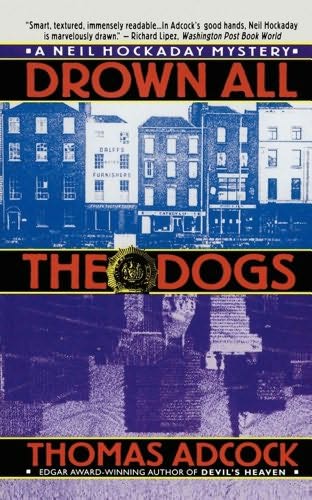
Drown All The Dogs: Thomas Adcock


Drown All The Dogs is a paperback I picked up at a great little store in Portland called Murder By The Book. I bought this book years ago and am only now finally reading it. I think I needed to read this book as an adult, as it's pretty thick stuff. It's an Irish cop mystery intricately woven with Irish history and literature.


Neil Hockaday is a New York cop of Irish descent who spends his time in Hell's Kitchen, trying to fill the "hollow places" inside him. Ruby Flagg is his gal pal who gives strong, independent woman a good name. In an effort to solve the mystery of Hockaday's faceless father, Neil and Ruby take a vacation across the pond to visit old Uncle Liam. From there, the mysteries pile up faster than the body count, with Neil at the epicenter.


I'm still not sure I fully understand this book. The Irish Republic Army, Nazis, secret organizations, and so much convoluted patriotism create a web of deceit that our New Yorker cop has to untangle to reveal the truth about his family. Unfortunately, some places are so tangled and dark that they may better be left alone.


While reading this novel, I couldn't help but wonder how much our family history defines us. For some folks, I think that lineage is just history. For others, I think that family is defining. What ugly secret would it take for you to disown your familial history? Imagine that you learned that your ancestors had committed horrendous crimes. How would that effect you?


Adcock is not the best, most articulate writer being published, but his story is detailed and smart. It takes a real talent to incorporate so much information into a novel and keep it interesting. What could read like a history book, instead reads like a novel, with developed characters and a driving plot line.

Saturday, June 20, 2009

The Pact: Jodi Picoult


The Pact is the third book I've read by Picoult and I'm noticing a disturbing trend; her stories are real enough and written well enough to jar my mind. I find myself instantly sucked into the story, only to be smacked by an uneasiness stemming from the realness of her writing. I suppose that's a commendation for Picoult. For me, it's a good enough reason to put her aside from now on.


The Pact is a misleading title, but that's only appropriate, as Picoult so often turns her stories towards the end in an effort to confound her reader. Picoult lovingly calls this a Love Story, though the love that she writes about is implausible, if not impossible.


Chris and Emily are born to neighboring families. They are raised together, and live as much with each other as they do with their own parents. Picoult goes through great effort to illustrate the closeness of their relationship as children and how it develops during adolescence. As is probably predictable, their parents are cheerleaders for the blooming relationship between the children. When they are caught kissing for the first time, the parents are actually gleeful. While it's all a very sweet thought, I also know that growing up that closely with someone may lead to some physical experimentation, but ultimately the only relationship that blossoms is that of siblings. Picoult does make it clear that the sibling factor occurs to both Emily and Chris, but it is easy brushed away so as not to remind the reader of incest.


The pact is in fact a suicide pact, further stereotyping teenage melancholy, and simultaneously downplaying real depression. I can't say too much more about the story without giving it all away, though I will tell you that Chris spends the majority of the book in the county jail.


My biggest problem with this story, other than the close-to-home reality of it, is that this novel can't seem to decide who it's about. Emily? Chris? The parents? Whose parents--Emily's, or Chris'? There are a number of players in this story including a defense attorney with a teenage son of his own, and each character has a different perspective. In this way, there is no bottom line truth in the story. The reader spend almost 500 pages hoping to get to the answer and there is no single answer! What's more, the reader is told a crucial piece of information in the first hundred pages or so and waits through the rest of the book for someone else to learn this piece of information, but waits in vain. It was incredibly frustrating to me.


This book came highly recommended, as did the previous Picoult novels. I don't deny her readability as an author. She is, in fact, a terrific writer, and I can even appreciate the stories she tells. However, if you are a sensitive reader, who is easily effected by words, Picoult may be a dangerous trigger.

Monday, June 15, 2009

Watership Down: Richard Adams


Watership Down is another one of those books on my "must read" list. It is often alluded to, and even shows up on many canon lists. I expected to pick up a piece of epic literature; a novel that would change my view of the world, or at least make me think about it.

Obviously, I was unaware that it was about rabbits.

This is not a novel about a sinking ship. It is, in some ways, a novel about war, but mostly, it's a novel about rabbits. Hazel, Fiver, Bigwig, and all of the other rabbits are in hot pursuit of freedom. The novel is broken into four parts relative to the various parts of their journey. The rabbits leave their home warren to find a new home where they are free to be wild rabbits. Then comes the segment where they must intrude on a neighboring warren to steal away some females so as to propogate. There, they run into some trouble and it becomes a bit of a war story. But have no fear, there is a happy ending. Because after all, this is a children's story.

Yes, you read that right--it's a children's story. Richard Adams wrote this novel much like Rowling wrote Harry Potter--as bedtime stories for his kids. As a lit person, I have been well trained to look for the allegory in every story. I look for hidden meaning in subtle symbols. About halfway through Watership Down I found myself floudering, unable to explain what the story was really about. So I did some research and found an interview with Adams in which he explains that the book was comprised of just a bunch of stories he told to his kids. He did mention that he may have woven stories of his own military experience into the story. But ultimately, it was just stories for his little girls.

The book has never been out of publication, and has been made into a movie (a cartoon). Would I recommend it? Sure--read it to your kids!

Sunday, May 17, 2009

Angels & Demons: Dan Brown

First of all, I want to apologize for being away from the blog for so long. I've had computer issues, and then I went on vacation. Needless to say, I've got a lot of catching up to do!


Dan Brown, the author of the well-known The DaVinci Code, actually wrote Angels & Demons first. This first novel of his is quite a bit darker than his other more publicized work. I was fortunate enough to catch a bit of an interview with Ron Howard and the main characters of the upcoming film and gained some insight into why The DaVinci Code was produced first. For one thing, as I noticed in my own readings, Angels & Demons jumps into the story without much character development of Robert Langdon. Whether that was intentional or if Brown simply became a more developed writer is unknown. In any case, Ron Howard felt that exposing the public to Robert Langdon in full dose by releasing Angels & Demons first, the audience would feel little empathy for a character who was basically a stranger. In The DaVinci Code, Howard was careful to help Tom Hanks fill out the character, and now, when we see him in Angels & Demons, he is a real person to us.


I think most important to note about this novel is that the Catholic church is no longer in direct light. It would be a simple overstatement to say that Angels & Demons is a story of good vs. evil, or wrong and right existing together to keep the checks and balances in place. This volume has a personal attachment that I didn't really feel from The DaVinci Code. The fact that this story involves men of the cloth isn't a condemnation because these men are drawn up as real people. The human element of this novel makes the murder and mystery all the more involved, and less about faith than it is about some of the basic human instincts.


To give a brief overview, Langdon is called in as a Symbologist Extraordinaire to help identify the creator of an Illuminati sign. What begins as an identification turns into a global manhunt. Meanwhile, a form of antimatter has been invented, and consequently stolen and is now being used as a weapon against Vatican City. It's a fascinating story from page one, if not slightly predictable once you get acquainted with all of the characters.


I enjoyed Angels & Demons, though I have to say, I think I preferred The DaVinci Code. Everyone told me that Angels & Demons was the better of the two novels, so I expected something to knock my socks off. I liked it, but I was far more intrigued by the mysteries of The DaVinci Code.