Showing posts with label Mystery. Show all posts
Tuesday, February 26, 2013
Rebecca: Daphne du Maurier
I first came upon du Maurier's Rebecca in a fellow book blog, despite it's standing as the classic that established du Maurier as one of the most popular writers of her time. But frankly, the story didn't capture me. An unnamed young woman, working as a companion to a stodgy old lady in Monte Carlo, encounters a handsome, wealthy, intriguing (read tall, dark, and handsome) gentleman whom she falls in love with. They get married, they honeymoon, and then they settle in at Mr. de Winter's home, Manderley. Side note, I simply love an estate with a name! Ah Manderley, where the head of housekeeping, Mrs. Danvers, still holds a flame for the late Mrs. de Winter, and where our young narrator believes her tall, dark, and handsome husband to regret their union due to an undying love for his deceased first wife. Sounds kind of, dare I say, dull? I now know that's because I was never introduced to Rebecca as a mystery. What sounds like a somewhat uninteresting tale of romance, is in fact an emotional roller coaster.
To begin with, du Maurier starts at the end. One of the most famous first lines ever written, "Last night I dreamt I went to Manderley again," takes place after the last page of the book. The trick is that by the time you get to the last page, you have been on such a journey with these multi-dimensional characters that you have forgotten how the story began. Which I suppose is a real testament to the meticulous story-telling of du Maurier. Her characters don't fall in love, they share quiet moments that bond them together. The narrator isn't just a young companion to a stodgy old lady, she is an incongruously naive girl who has traveled at the side of her employer. The staff at Manderley aren't just background housestaff, they are characters with motivations and emotions of their own that are described by their dialogue and their actions. To say that du Maurier has written a fine novel is an understatement. What she has really accomplished is the creation of an entire world that stands on it's own, and she has done so with a murderer amongst her cast!
I admit it takes a bit of time to become fully involved with Rebecca, but isn't that the way with real people? Humans are apt to share bits and pieces of themselves with us in small manageable chunks. So it is with Rebecca; we are slowly introduced to our cast as well as the Manderley estate. The many secrets are parceled out like rations so as not to spoil the mystery all at once. This isn't one of those mystery novels where you get an intuition from the very beginning about "whodunnit". Instead, the reader learns tidbits of information as our narrator does, never knowing more than the young Mrs. de Winter.
Simply stated, this book isn't for everyone. It's a classic mystery with a touch (maybe more like a handful?) of the Gothic tale. It's not action packed, and the murder is over and done with by the time we pick up the book. It is, however, an intriguing little mystery with twists and turns and a very fine line between good guys and bad guys.
Rating: $$.5
Thursday, January 12, 2012
The Girl With The Dragon Tattoo: Stieg Larsson
I have a tendency to be behind the times. If a book series is a huge hit and sells out everywhere and makes all of the top ten lists...chances are I haven't read it yet. By the time I picked up my mass market paperback copy of The Girl With The Dragon Tattoo, I think the third book in the series had already been published. And it wasn't until last week when I finally picked up the hefty volume and decided to dive in.
Here's the thing about this book. It's not a story you can love. First of all, it moves achingly slowly through the first half, and then rushes right to the end in a way that left me feeling a little like I had just nearly drowned and come back to life, gasping for air and totally disoriented. It's also incredibly painful. Every character in this book is wounded in one way or another. It is worth noting that the original Swedish title is Men Who Hate Women, which tells you something about the kind of people who populate Larsson's novel.
However, here's the other thing about this book. It is intense and exciting. It is exhilarating and emotional. Not unlike the mafia, once you're in, you're in for life. The characters are so well written and well developed that they become fully dimensional people. This is one of those books which people talk about as if it were a real story, repeating bits of dialogue as if they had heard sound bytes on the evening news. For all it's faults, and certainly every book has one or two, this novel has become a part of our culture.
The story, as I mentioned, starts out slow. Mikael Blomqvist is a newspaper reporter who is being tried for libel against a very large, very powerful company. There are a ton of facts and pieces of history and some lame, limping outlines of a relationship that Mikael has with his editor. Meanwhile, we meet Lisbeth Salander who is under guardianship due to a history of anti-social behavior and general balking at authority. Her most recent and most lenient guardian has just passed away and she has been awarded to a new court-appointed guardian who seems hell-bent on lording his control over her. Lisbeth works for Milton Security, which appears to hire her out as a freelance private investigator. She has this uncanny ability to uncover every minuscule secret of a person's life without their ever knowing. It is this talent of hers that brings her together with Mikael Blomqvist. Mikael is hired by Henrik Vanger to investigate, and hopefully to solve, the 30 year old disappearance of his niece, Harriet. Mikael and Lisbeth become an intimate team in the effort to unravel the many mysteries of the Vanger family and discover what happened to Harriet.
The mystery is meticulously woven and then uncovered, the characters are dimensional and intelligent, the surprises are many, and the heroics are indeed heroic. Lisbeth Salander is both inspiring and pitiful. Mikael is at once brilliant and doltish. The mystery is predictable, and then completely shocking. As a warning to more sensitive readers, I do have to say that there is foul language, violence, and sex. However, it all felt right. Larsson has me hooked and I'm anxious to see what unfolds in the next book.
Rating: $$$
Friday, December 16, 2011
Burnout: Adrienne Maria Vrettos
Burnout is the story of Nan, a teenage girl who wakes up the morning after Halloween with no recollection of the night before. She wakes up on subway train wearing make up and a costume she doesn't remember. The problem is, while this would not have been unusual for Nan six months ago, she has since been through rehab, confronting her demons and leaving blackouts in the past. I was instantly intrigued by the idea of this mystery, so I was very excited when I won this book from GoodReads FirstReads.
At the heart of this novel is a girl who, I think, just wants to be good. Her home life is kind of a mess, so when she meets outrageous Seemy, Nan desparately wants to be her friend. Where Nan is big boned and amazon-esque, Seemy is petite and lithe. Nan is grounded and steady; Seemy is flighty and spontaneous. Nan falls in love with Seemy who prefers to avoid complex emotions in favor of one-night-stands with losers. Friendship with Seemy means skipping school to get drunk in the movie theater, or stand guard while she hooks up with a random guy in their sacred Carriage House. Despite it being a damaging friendship, Nan hangs on tightly to the lively girl who makes her feel special. Nan is a relatable character--most people, at one time or another, have been willing to forego rationality for the sake of affection from someone they love. For this reason, I care about Nan and how she came to wake up from a blackout after so many months in recovery.
I don't want to ruin the mystery, but I will say that not every question is answered...much like real life. There is some real terror in this story, inducing a heartwrenching kind of ache for these girls who are making choices that will impact their lives in significant ways. It's a fast read with memorable characters. Vrettos deserves the many accolades she has received this year for her stellar writing.
Rating: $$.5
Received courtesy of GoodReads FirstReads.
Friday, July 1, 2011
A Great And Terrible Beauty: Libba Bray
Don't you hate it when you pick up a book and only after getting involved in the story, find out that it's the first in a trilogy? Because now I'm totally hooked and I will not be able to sleep until I find the other two books in this series and devour them.
It's the late 19th century in India and sixteen year old Gemma Doyle has started having visions--visions that quickly become reality. After witnessing her mother's strange death, Gemma is sent to an all girls boarding school in England where she encounters an unusual gypsy named Kartik who warns her against using her new-found powers. As a social parriah, Gemma befriends Ann, "the scholarship girl", who is the victim of ceaseless bullying from the most popular girls. When Gemma finds leader-of-the-pack Felicity in a compromising situation, she enters into a manipulative friendship with Felicity and her cohort, the beautiful Pippa. After Gemma finds the secret diary of Mary Dowd--a former student-- that explains the powers that Gemma has uncovered, life takes a turn for the wonderful. Gemma, Ann, Felicity, and Pippa form a kind of coven in which they wield powers beyond mortal recognition. Gemma acts as a conduit for the "great and terrible" powers, making her very popular while honing her skills. It doesn't take long for the power-hungry Felicity to get carried away, and soon Gemma is forced into making a decision that may cost her everything.
This review is difficult to write because there is SO much happening. The cast is wide and diverse and the story is complicated. I loved it! I'm just not sure how to tell you readers what I loved about it. Gemma is awesome, I like her as a person. I loved the Realms and the possibilities they offered. The scenes of magic are technicolor in their descriptions and creativity. The prose isn't stunning, but Bray is a wonderful storyteller. I don't know what else to tell you about this book except, go get it!
Rating: $$$
Tuesday, March 22, 2011
In Desperation: Rock Mofina
As much as I love crime-fighting movies and television shows, I am rarely intrigued by books of the same genre. I suppose that's because visual entertainment still pales in comparison to an active imagination. However, for whatever reason, Rick Mofina's action-packed novel caught my attention and demanded I give it my time.
Single mother Cora and her daughter Tilly are spending a quiet evening at home when two men posing as police officers arrive and kidnap Tilly. Cora is left with the daunting message that if her boyfriend, Lyle Galviera doesn't return the five million dollars he stole from Norte Cartel--the largest Mexican drug cartel--then Tilly will die. Of course Lyle is nowhere to be found, and with the threat of her daughter's life on the line, Cora calls her reporter brother, Jack, rather than contacting the police. Cora and Jack have been estranged for twenty years, causing layers of guilt and doubt to complicate their situation. Once Jack convinces Cora to involve the police, things start unfolding. In Desperation takes place over five excruciating days, while Tilly's life hangs in the balance. The Norte Cartel are closing in on Lyle Galviera and have dispatched a notorious assassin to get rid of him as well as Tilly. Meanwhile, Cora is holding back a secret that may explain how the cartel became involved with the Gannon family in the first place.
I dragged my feet through this novel. I was interested in the storyline, but Cora frustrated me to no end. I had the feeling that if I were faced with her, I'd slap her. It's a fairly graphic novel, detailing the ways that drug cartels handle vengeance, but that also makes it an exciting story, filled with action and heart-pounding chapters, making this a page-turner.
Rating: $$
ARC received courtesy of MIRA Imprint
Tuesday, February 22, 2011
No Place Like Holmes: Jason Lethcoe
What do you get when you introduce Encyclopedia Brown to Sherlock Holmes? You get Griffin Sharpe--a genius with a knack for observation.
Griffin Sharpe is a very observant boy. His keen eye and mathematical mind have caused him a bit of trouble in his short life, but Griffin knows that his skills will serve a purpose. In 1903 he is sent to his uncle's for the summer. On his journey to London, England, Griffin learns about the great detective, Sherlock Holmes. Inaccurately believing that the uncle he has never met is Mr. Holmes, Griffin is surprised to find that his uncle is actually Rupert Snodgrass: a lesser-known detective who happens to live in the same building as Sherlock Holmes--literally in his shadow. Griffin proves to be an invaluable asset to his grumpy uncle as they set out to unravel the mystery of a man believed to have been eaten by the Lochness Monster.
Jason Lethcoe has brought a classical fiction character to new light, as seen through the eyes of an intelligent young detective. What a wonderful way for a new generation to fall in love with Sherlock Holmes! All the old fellas are there, including Watson and Moriarty. The adventure and excitement of this novel may seem predictable to adult readers, but to the young audience, it is a maze of intrigue that every young sleuth will enjoy unraveling.
No Place Like Holmes wraps up in such a way that leads me to believe--to hope!--that we haven't seen the last of Griffin Sharpe and his eccentric uncle.
Rating: $$
ARC received courtesy of Tommy Nelson.
Wednesday, January 26, 2011
The Reservoir: John Milliken Thompson
I'm not usually a fan of mystery novels. Not for any particular reason other than they don't usually grab my attention. However, something about The Reservoir intrigued me. Maybe it was because the story is set in 1885. Maybe it was because the mystery revolves around a pregnant dead girl found floating in the town reservoir. Maybe it was because Thompson based his novel on a true story.
There are three characters at the heart of Thompson's novel: Tommie, his brother Willie, and their cousin Lillie. On March 14,1885 a body is found floating in the reservoir in Richmond, Virginia. The body turns out to be a pregnant Lillie. The rest of the book is the story of Tommie's trial for the murder of his cousin, interspersed with Tommie's flashbacks that fill out the narration. Tommie files a not guilty plea, but his private narration alludes to his struggle regarding "the truth". Here is the truth; Thompson has written a novel based on an actual court case that is riddled with holes and unanswered questions. I warn you now, this book doesn't tell you outright if Tommie was guilty or innocent. Which makes The Reservoir a very well constructed character study, because while there is a plot line in this novel, I feel like the plot isn't as important as the people.
Though Tommie is the narrator, this story really belongs to Lillie. Sweet, young, naive Lillie who caught the attention of her Cluverius cousins at a young age, practiced seducing them both, but fell in love with Tommie. When she becomes pregnant, Lillie begs Tommie to marry her, knowing that having a baby out of wedlock will ruin her for marriage with anyone else. But is it actually Tommie's baby? When Tommie--who is on the verge of a bright future in law--rebuffs Lillie, she is devastated. Is it enough for her to take her own life?
The Reservoir is a classic example of excellent storytelling. Thompson has taken a few rusty court case notes and expanded them into a fully dimensional novel. I was slow getting through this one, but the story kept me interested.
Rating: $$
ARC received courtesy of Other Press.
Monday, December 20, 2010
The Mistress of the Art of Death: Ariana Franklin
I have no idea why I picked up this book. It was on sale and then also on clearance. I was in a mood to read something Victorian. The cover art was interesting. I honestly don't know what compelled me to pick up this book, especially since it's not the kind of thing I normally read, but I'm glad I did!
The story begins with a band of travelers on their way to Cambridge in the twelfth century. Among the travelers is a killer. A murderer and sodomizer of children who has been kidnapping, raping, and murdering children of Cambridge and blaming it on the Jewish community. Also among the travelers is a woman doctor from Salerno, trained in the Art of Death--we would call her a coroner. Adelia, along with Jewish detective Simon and Muslim eunuch Mansur, has been sent to Cambridge by the King of Italy to quietly assist in the case. Determined to unearth the deranged killer and clear the Jews of any wrongdoing, the trio embark on a covert mission to infiltrate the community and learn as much as they can. The list of suspects quickly thins out until even the reader thinks they know whodunnit. However, as any good mystery will do, this story takes a wild turn for the unexpected that will likely leave you shocked and disgusted.
This isn't a new story. It's not even a sort-of-new story. In fact, as the author writes in the Author's Note, there was in fact a string of kidnappings in the twelfth century that was blamed on the Jews. However, what makes this novel so refreshing is the pure talent that Franklin delivers. At first I thought she was simply verbose. So many, many words! And yet it is obvious that author and editor alike have combed this novel within an inch to ensure that every word is necessary. The descriptions are intensely satisfying, reanimating an entire era and culture. The characters are colorful and independent; there is no confusion with overlapping traits as are so often found with lazy contemporary authors. And the villain. It has been awhile since such a monster made it's way into mainstream media. I don't remember an antagonist so humanly grotesque since George Harvey of The Lovely Bones. And I do mean grotesque. Sensitive readers should steer clear!
By far the most interesting character in this novel is Adelia. An educated woman in the twelfth century was most likely to be hanged/drowned/burned for witchcraft. To be a competent woman, trained to put together the pieces of a body's death, carries a stigma even in our "enlightened" 21st century. Adelia is also without faith, believing instead in science, which is one more mark against her favor. She is also young, unmarried, and intentionally celibate. Realistically, she seems more like someone who would exist on the Sarah Lawrence campus in the late 1990's.
While The Mistress of the Art of Death is gruesome, it is also a fantastically crafted thrilling mystery.
Rating: $$.5 (The gore kept it from receiving $$$)
Wednesday, February 10, 2010
The Lovely Bones: Alice Sebold
When The Lovely Bones first hit bookstores a few years ago, I was curious about it, but ultimately decided to skip it. As a general rule I don’t go in for a lot of gore, so reading about the rape and murder of a teenage girl wasn’t the least bit appealing. However, in my spare time I’m also a movie buff. So when I saw that The Lovely Bones was going to be made into a movie (with Stanley Tucci!), I bit the bullet and ordered myself a copy. My overall opinion is that I wasn’t missing much by not reading it.
The Lovely Bones is disturbing and gory. Which are actually testaments to the great writing of Alice Sebold. I’m just not sure it’s a great book. The story was sometimes uncomfortable to read. And rather than be about the search for Susie Salmon’s killer, it’s about what happens to a family and community after the death of a young girl, which was only interesting for about a hundred pages. The family reaction was fairly cliché—the parents grow distanced when one of them becomes obsessed with finding Susie’s killer. Her siblings fall into the shadows as the sad survivors of a family torn apart by the loss of a child. And Susie’s friends from school react by finding solace in each other, which feels a little uncomfortable in itself.
I think that what makes this story silver-screen-worthy is that it’s believable. We have become all-too-familiar with the reality of the neighborhood sociopath who preys on our children. What Sebold has managed is to make Susie’s killer dimensional. He is cold and calculating, but she gives him thought processes and determined decisions that effectively bring him to life. If it weren’t for Sebold’s writing skill, I don’t think this book would have made it beyond the thrillers section into the best-selling shelves it stands on today.
Rating: $$
Sunday, January 17, 2010
The Thief Lord: Cornelia Funke

Prosper and Boniface (Bo) are brothers who have run away to Venice. After the death of their parents, greedy aunt Esther offered to adopt the adorably angelic Bo, but wanted nothing to do with the slightly older Prosper. Refusing to be separated, the boys run away to Venice—a city their mother frequently spoke of as wonderful and magical. They are soon adopted into a group of other street children who are living in an abandoned movie theatre. They live off their wits and the money they earn by selling loot that the Thief Lord steals from the grand houses of Venice. When the Thief Lord is asked to take on a special mission of thievery, his own secrets are brought to light, and the band of runaways may never be the same.
The Thief Lord is an extremely entertaining story, full of mystery and excitement, action and tenacity. Cornelia Funke earned my adoration with her Inkspell novels, and her creative imagination. The story of the Thief Lord is really about Prosper and Bo and their search for a safe and comfortable home. The adventures along the way—starring Scipio, Riccio, Mosca, and Hornet—are a thrill ride, exposing each character as a dimensional individual.
Ultimately, the plot revolves around a magical merry-go-round located on the Isola Segreta—the secret island. The legend says that the merry-go-round will make children into adults, and adults into children. Of course, as a group of young runaways constantly harassed by authorities, the group of children is very interested in finding the merry-go-round and changing themselves into adults as soon as possible. There is a rather heavy-handed moral here that explicitly illustrates that no one should take their age for granted. When a child is turned into an adult, he is at a loss as to what an adult does all day. When an adult is turned into a child, he is frustrated at his inability to be taken seriously. The lesson is laid on pretty thick, but I suppose that’s to be expected in a young adult novel.
Overall, this is a really fun novel. It’s kind of mystical and magical, but it’s also mysterious and intriguing. I think it’s a fun novel for the young and old alike.
The Thief Lord is an extremely entertaining story, full of mystery and excitement, action and tenacity. Cornelia Funke earned my adoration with her Inkspell novels, and her creative imagination. The story of the Thief Lord is really about Prosper and Bo and their search for a safe and comfortable home. The adventures along the way—starring Scipio, Riccio, Mosca, and Hornet—are a thrill ride, exposing each character as a dimensional individual.
Ultimately, the plot revolves around a magical merry-go-round located on the Isola Segreta—the secret island. The legend says that the merry-go-round will make children into adults, and adults into children. Of course, as a group of young runaways constantly harassed by authorities, the group of children is very interested in finding the merry-go-round and changing themselves into adults as soon as possible. There is a rather heavy-handed moral here that explicitly illustrates that no one should take their age for granted. When a child is turned into an adult, he is at a loss as to what an adult does all day. When an adult is turned into a child, he is frustrated at his inability to be taken seriously. The lesson is laid on pretty thick, but I suppose that’s to be expected in a young adult novel.
Overall, this is a really fun novel. It’s kind of mystical and magical, but it’s also mysterious and intriguing. I think it’s a fun novel for the young and old alike.
Sunday, November 29, 2009
Dead Until Dark: Charlaine Harris

Charlaine Harris is the author of the Sookie Stackhouse series—the books on which HBO’s True Blood is based. As a resident of the deep south, Harris writes the Stackhouse novels with authority, bringing Bon Temps, Louisiana alive with dark, foreign descriptions. While her story and descriptions are vivid, her characters sometimes lack dimension. I find Sookie Stackhouse to be the weakest of all Harris’ characters; she is a telepathic waitress who falls in love with a vampire (and has all the personality of Twilight’s Bella Swan).
Harris’ greatest achievement in Dead Until Dark is not the descriptions of Louisiana, or the lackluster characters, but the society she has created in her books. In her world, vampires have “come out of the coffin” (a charming turn of phrase that reminds the reader that vampires are a minority), and are living amongst general population. They feed off of “fang-bangers” who are essentially blood prostitutes who allow themselves to be bitten, but not drained. Vampires who choose to “mainstream” may choose to live on the synthetic bottled blood, made available in most bars and restaurants (the stuff even comes in flavors—A negative, O positive, etc).
Dead Until Dark introduces the reader to the protagonist, Sookie Stackhouse—a pretty young woman who is uneducated, but not stupid. She was born telepathic and that talent has caused her no end of grief all her life, so she has chosen to live as simple a life as possible. She has learned, over time, to control her mind. She is able to put up her guard and block everyone’s thoughts, but it takes a lot of energy. Sookie lives with her Gran, and has ever since her parents died. Her older brother, the charming (and fairly sleazy) Jason, lives in their old house and works at a non-descript hillbilly job. He spends his time chasing skirts and getting drunk. Overall, the characters and town of Bon Temps are about as interesting as any four-way stop called a town.
In walks Bill. Bill Compton, also known as Bill the Vampire. After the vampires gained public freedom, he chose to return to his old homestead in Bon Temps. In about 24 hours, he meets and falls in love with Sookie, who finds herself equally enamored. However, as with any small town, bigotry still exists in Bon Temps, and when people start showing up dead, all eyes turn to Bill. Just because vampires have been given rights, doesn’t mean everyone likes them. This is where Harris reeled me in. She has taken a fairly innocuous fad—vampires—and created a beautiful analogy for bigotry. We live in a society that claims to accept all people and wants to give all people fair and equal rights. But the reality is that fear exists, and that fear turns into hatred. That’s when the lynch mobs show up. Which is exactly what happens in Bon Temps.
The real murderer is not a vampire at all. Harris wraps up her story by solving the mystery and allowing Sookie and her vampire to ride off into the sunset. Well, into the next book, anyway. I have to mention that the first season of True Blood is taken almost exactly from this first book, save a few minor characters and unimportant events.
Harris’ greatest achievement in Dead Until Dark is not the descriptions of Louisiana, or the lackluster characters, but the society she has created in her books. In her world, vampires have “come out of the coffin” (a charming turn of phrase that reminds the reader that vampires are a minority), and are living amongst general population. They feed off of “fang-bangers” who are essentially blood prostitutes who allow themselves to be bitten, but not drained. Vampires who choose to “mainstream” may choose to live on the synthetic bottled blood, made available in most bars and restaurants (the stuff even comes in flavors—A negative, O positive, etc).
Dead Until Dark introduces the reader to the protagonist, Sookie Stackhouse—a pretty young woman who is uneducated, but not stupid. She was born telepathic and that talent has caused her no end of grief all her life, so she has chosen to live as simple a life as possible. She has learned, over time, to control her mind. She is able to put up her guard and block everyone’s thoughts, but it takes a lot of energy. Sookie lives with her Gran, and has ever since her parents died. Her older brother, the charming (and fairly sleazy) Jason, lives in their old house and works at a non-descript hillbilly job. He spends his time chasing skirts and getting drunk. Overall, the characters and town of Bon Temps are about as interesting as any four-way stop called a town.
In walks Bill. Bill Compton, also known as Bill the Vampire. After the vampires gained public freedom, he chose to return to his old homestead in Bon Temps. In about 24 hours, he meets and falls in love with Sookie, who finds herself equally enamored. However, as with any small town, bigotry still exists in Bon Temps, and when people start showing up dead, all eyes turn to Bill. Just because vampires have been given rights, doesn’t mean everyone likes them. This is where Harris reeled me in. She has taken a fairly innocuous fad—vampires—and created a beautiful analogy for bigotry. We live in a society that claims to accept all people and wants to give all people fair and equal rights. But the reality is that fear exists, and that fear turns into hatred. That’s when the lynch mobs show up. Which is exactly what happens in Bon Temps.
The real murderer is not a vampire at all. Harris wraps up her story by solving the mystery and allowing Sookie and her vampire to ride off into the sunset. Well, into the next book, anyway. I have to mention that the first season of True Blood is taken almost exactly from this first book, save a few minor characters and unimportant events.
Monday, November 23, 2009
The Girl Who Stopped Swimming: Joshilyn Jackson

I read The Girl Who Stopped Swimming in about two days. An innocuous hardcover volume with an alluring title and cover, this book is possibly the hardest I’ve ever had to review. I simply have no idea where to start! It is so filled with story, emotion, social commentary, and fantastic writing that I find it hard to separate the elements and gather my thoughts into any kind of cohesive form. That said, bear with me as I try to articulate this novel into a review.
Laurel sees ghosts. She was haunted by the ghost of her uncle Marty after he died in her childhood, but he disappeared from her nights when she moved to the gated community of Victorianna when she got married. Now she’s living a relatively average life as a wife to computer programmer David, and mother to teenage daughter Shelby. Average until she wakes up one night to find a dripping wet neighborhood girl standing in her bedroom. The ghost is that of Molly, a neighborhood kid and friend of Shelby. Molly’s ghost directs Laurel to the swimming pool in the backyard where Molly floats, face down and bloated. The death of the neighborhood girl is a trigger that sends Laurel and her family on an emotional roller coaster. Laurel brings her willful sister Thalia to stay with her, which brings past events into light that explain why Marty’s ghost haunted Laurel as a child. While facing long repressed demons, Laurel tries to maintain her grip on her family, who are rapidly unwinding.
Around the edges of this story is a theme of social morality. Laurel and Thalia were rescued from an Appalachian life in a small town called DeLop by their strong-willed mother who pulled herself out of the mining town through a successful marriage, never to look back. DeLop is described in cruelly clear detail as a place where children never graduate junior high school, and people develop addictions to ward off the misery. Laurel tries to protect Shelby from the ugliness of such a place by never taking her back to visit the cousins left behind. When Shelby shows interest in knowing how the other half lives, Laurel bends, allowing Shelby to make a DeLop pen pal named Bet. In Bet, the differences between Victorianna and DeLop are highlighted. Where Shelby is educated and healthy, Bet speaks with the twang of her DeLop upbringing and is starkly malnourished. Joshilyn Jackson has put a lot of thought and care into the details of illustrating the disparity between the haves and the have-nots.
While this novel could easily be about the accidental drowning of a young girl and stop there, Jackson is unmerciful in her efforts to make the death only the tip of the iceberg. There is so much meat to this story that it hooks the reader on many levels. I felt my heart strings tugged and my guts wrenched, my mind working overtime to figure out whodunit and my anxiety peaked as the story unraveled. Jackson is definitely a writer worth reading.
Laurel sees ghosts. She was haunted by the ghost of her uncle Marty after he died in her childhood, but he disappeared from her nights when she moved to the gated community of Victorianna when she got married. Now she’s living a relatively average life as a wife to computer programmer David, and mother to teenage daughter Shelby. Average until she wakes up one night to find a dripping wet neighborhood girl standing in her bedroom. The ghost is that of Molly, a neighborhood kid and friend of Shelby. Molly’s ghost directs Laurel to the swimming pool in the backyard where Molly floats, face down and bloated. The death of the neighborhood girl is a trigger that sends Laurel and her family on an emotional roller coaster. Laurel brings her willful sister Thalia to stay with her, which brings past events into light that explain why Marty’s ghost haunted Laurel as a child. While facing long repressed demons, Laurel tries to maintain her grip on her family, who are rapidly unwinding.
Around the edges of this story is a theme of social morality. Laurel and Thalia were rescued from an Appalachian life in a small town called DeLop by their strong-willed mother who pulled herself out of the mining town through a successful marriage, never to look back. DeLop is described in cruelly clear detail as a place where children never graduate junior high school, and people develop addictions to ward off the misery. Laurel tries to protect Shelby from the ugliness of such a place by never taking her back to visit the cousins left behind. When Shelby shows interest in knowing how the other half lives, Laurel bends, allowing Shelby to make a DeLop pen pal named Bet. In Bet, the differences between Victorianna and DeLop are highlighted. Where Shelby is educated and healthy, Bet speaks with the twang of her DeLop upbringing and is starkly malnourished. Joshilyn Jackson has put a lot of thought and care into the details of illustrating the disparity between the haves and the have-nots.
While this novel could easily be about the accidental drowning of a young girl and stop there, Jackson is unmerciful in her efforts to make the death only the tip of the iceberg. There is so much meat to this story that it hooks the reader on many levels. I felt my heart strings tugged and my guts wrenched, my mind working overtime to figure out whodunit and my anxiety peaked as the story unraveled. Jackson is definitely a writer worth reading.
Sunday, November 15, 2009
Visions of Sugar Plums: Janet Evanovich

Known for her hilarious, action packed mysteries, Janet Evanovich takes her leading lady, Stephanie Plum, on a romp of a holiday ride in Visions of Sugar Plums. Bounty hunter Stephanie Plum finds herself four days away from Christmas with no decorations or presents in sight. Waking up to find a sexy hunk of a man in her kitchen, she starts on a Christmas adventure she won’t soon forget.
The hunky blond goes by the name of Diesel and proclaims himself to be of the supernatural variety. He says that he was sent to her to give her some holiday cheer. I know that at this point, the novel sounds like it’s on its way to becoming a bodice-ripper romance. On the contrary, Diesel and Stephanie find that they are facing the same foe. While Stephanie is on the hunt for a man named Sandy Claws who jumped bail, Diesel is looking for Sandy’s nemesis, Ring. It doesn’t take long for Ring to zero in on Stephanie and her efforts to lock Sandy behind steel bars for the holiday. Stephanie shrugs off the absurdity of supernatural beings with single word monikers and dives into the madness. As Christmas inches closer, the panic over Christmas trees and presents, family dramas and parent-pleasing increases. In some ways, the story is incredibly realistic!
Evanovich has spun a deliciously fun little holiday yarn, using her eclectic cast of characters, including the foul-mouthed Lula, who appears in one scene wearing red Lycra pants and a sweater adorned with a giant felt Christmas tree. I can’t say that there’s a lot of mystery to this novel, but it is certainly entertaining.
The hunky blond goes by the name of Diesel and proclaims himself to be of the supernatural variety. He says that he was sent to her to give her some holiday cheer. I know that at this point, the novel sounds like it’s on its way to becoming a bodice-ripper romance. On the contrary, Diesel and Stephanie find that they are facing the same foe. While Stephanie is on the hunt for a man named Sandy Claws who jumped bail, Diesel is looking for Sandy’s nemesis, Ring. It doesn’t take long for Ring to zero in on Stephanie and her efforts to lock Sandy behind steel bars for the holiday. Stephanie shrugs off the absurdity of supernatural beings with single word monikers and dives into the madness. As Christmas inches closer, the panic over Christmas trees and presents, family dramas and parent-pleasing increases. In some ways, the story is incredibly realistic!
Evanovich has spun a deliciously fun little holiday yarn, using her eclectic cast of characters, including the foul-mouthed Lula, who appears in one scene wearing red Lycra pants and a sweater adorned with a giant felt Christmas tree. I can’t say that there’s a lot of mystery to this novel, but it is certainly entertaining.
Thursday, October 1, 2009
The No. 1 Ladies' Detective Agency: Alexander McCall Smith

The No. 1 Ladies' Detective Agency is now an acclaimed tv series, based on this textured novel about Mma Ramotswe and her life as a lady detective in Botswana. A little slice of Africa, this novel illustrates all of the beautiful and warm things about an ancient country, as well as some of the culturally significant differences that make Africa so foreign.
Mma Ramotswe is the daughter of a wealthy cattleman. The story starts out with the death of her father, leaving his wealth to Mma Ramotswe to buy a shop. She opens a detective agency as the only female private detective in Botswana. It's quite charming how she faces anyone who challenges her qualifications. In a male-dominated society, a female detective is suspect, but Mma Ramotswe knows what she's good at! She opens her doors and encounters all types of mysteries, from the disappearance of a young boy, to the wandering off of a husband, to the fraud of a lost finger.
Mma Ramotswe is a fantastic, warm, real-life character who is an instant friend to the reader. The people she encounters are all so colorful and interesting. This is not a fast-paced detective novel; just an entertaining group of stories about some Botswana people. It's fun and clever, and if you pay attention, you'll learn a little about African culture.
Tuesday, September 22, 2009
The Last Thing I Remember: Andrew Klavan

Imagine waking up one morning, not knowing where you are and overhearing the order for your death. Imagine learning that everything you know about your life, your world, and even yourself is a lie. What would it take for someone to convince you that you are not who you think you are? How hard would you fight for what you believe to be the truth?
The Last Thing I Remember is a cross between The Bourne Identity and 24. It's fast paced and action-filled, with a likable protagonist. Charlie West is a 17 year old kid who sees the world in black and white terms--good guys and bad guys. He believes in America, in God, and in being the best guy he can be. He excels in all areas of life: school, karate, family. Life, generally speaking, is good.
Life is good, that is, until he wakes up in a cement cell, chained to a chair where he has been tortured, and overhears the order for his death. From that point on, Charlie is in a race to save his own life. Things get complicated, however, when he learns that he is being pursued by not just the bad guys (Islamic terrorists), but the good guys (American Law Enforcement) as well. Everything that Charlie has always believed about himself is put into question and he is forced to examine what he knows to be true versus what he is told about himself.
The tones of Patriotism and Religion are thick in this novel, which at first made me uncomfortable. However, as the story unfolds, the importance of those themes begins to make sense as a necessary part of the plot. Charlie West seems like a somewhat overdone hero--I mean realistically, how many 17-year-olds could un-arm and outwit a group of Islamic terrorists intent on ending his life?--but he is also plausible in many ways. He gets nervous around girls, he's shy, he dislikes his older sister simply for being an annoying older sister, he stresses out about grades and college. He is simultaneously a superhero and the boy next door.
The Last Thing I Remember is the first book in the Homelander Series, and my interest is admittedly piqued. I'm interested to see how the story of Charlie West is going to unravel.
Saturday, August 29, 2009
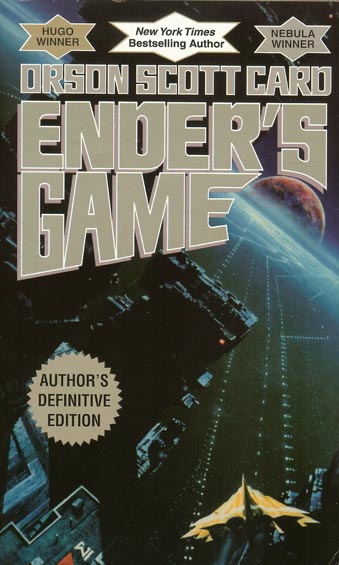
Ender's Game: Orson Scott Card

Ender's Game is one of the Modern Library Reader's List Top 100 Novels; a list which I am trying to read through. It is also a novel I thought I had read in middle school or high school, but after reading it, I know this is my first read. I have heard of young adults reading this book, but I now think that the themes of warfare and psychological manipulation may be too advanced for some younger readers. I don't know that I would present this book to just any group of 8th graders--they would have to be mature and intelligent enough to comprehend the gravity of the story.
Imagine a world in which alien lifeforms have presented themselves as our enemy. There have been two previous wars with these aliens, and our world as we know it has changed completely. For one thing, space travel has become common and "big brother" monitors us by controlling our households. Families apply to have children, and at any moment a promising child may be taken away for government purposes. Ender is just such a child. He is the third child, which is a rare occurrence in itself. He is chosen by the government at the age of 6 to be groomed as a warfare commander. He is taken off Earth and put into the Battle school where he first learns how to fight, and then how to lead. He is a only a child, but the future of Earth and all mankind is put into his hands. The trick of it is, he has no idea. To Ender, it's just a big game that he excels at. He is aware that at some point in the distant future, as an adult, he may be chosen to be a commander, but he has no idea that he will fulfill that mission long before he is 16 years old.
Ender is a brilliant child who has equal parts aggression and compassion, making him the perfect candidate to lead an army. He can not only predict how the alien species will act, but he is strong enough to oppose them as well. He has quick thinking and is able to keep his army out of danger. He is also emotionally immature, frustrated by manipulating teachers, and heartbroken by a family that is never quite what he wants them to be.
Ender's Game has been heralded as "a scathing indictment of the military mind" (Library Journal). I read the military mind as malleable and gullible. Ender was an exception because he was aware of how he was being tested at every turn. He knew he was being manipulated and he used that knowledge to his own advantage. It is the other students at the battle school who illustrate perfectly the competitive and brainless spirit of military pawns. They act without question and have only success in mind. It is Ender who has to be reminded of how wonderful Earth is and that its human connections are worth fighting for. He simply doesn't have enough competitive spirit to keep him fighting without question.
To analyze this entire novel and discuss the many layers and themes would take at least an 8 page essay, so I'll leave the analyzing to someone else. I will state that I enjoyed the reading of Ender's Game and think it is an important novel. The most important aspect of the novel is in the last chapter. I believe it's true that compassion and understanding may well be the key to survival of our species.
Monday, August 17, 2009
Alias Grace: Margaret Atwood

In 1843 Grace Marks was arrested along with James McDermott for the murders of Thomas Kinnear and his housemaid Nancy Montgomery. Grace and James were employed by Kinnear and were accused of first murdering the maidservant and quartering her, and then shooting and killing the master of the house. The supposed motive for the murders was lust and jealousy, as the testimonies put everyone in everyone else's bed. Grace was just sixteen years old.
It was, of course, a great scandal at the time. A young girl, so innocent in appearances and history, being taken into the folds of an evil plot. There were also rumors that the maidservant had been impregnated with Kinnear's child before her death. It was a headlining news story in Canada, America, and Britain. The trial for Thomas Kinnear's murder was held first, and as McDermott and Marks were both found guilty and sentenced to death, the trial of Nancy Montgomery's death was never held as it was considered redundant. It was only the outcry by a group called The Committee For The Commutation of Grace Marks that she was not hanged until dead. She was instead sentenced to life imprisonment, which was very fortunate, as she was in fact later commuted and pardoned after serving just twenty-nine years of her life sentence.
Atwood has taken all of the transcripts and news articles, the psychological reviews and personal interviews into consideration. She has remained as accurate as possible in her fictional retelling of the story of Grace Marks. The problem there is that the stories are all so conflicting. Grace Marks tried to maintain that she was unconscious during the murders and had no recollection whatsoever of the twenty-four or so hours during which McDermott committed his crimes, but one of her many confessions states that she was an unwilling participant in parts of the murders. And McDermott himself gave multiple confessions, including one version in which he was a mere pawn in Grace Marks' plot, in which she wooed him with sexual invitations to convince him to do her bidding. Really, it's all very thickly layered on. I don't know how a jury ever managed to convict considering the complete lack of consistency. It just goes to show, when at a loss to prove your innocence, confuse 'em with as many stories as possible!
In my (para)professional opinion, after having read this novel as well as some other sources of fact, I believe that Grace Marks may well have been schizophrenic. During the times when she was unconscious, her witnessed behavior was different, and quite coarse in comparison to her usual prudish nature. Some psychologists chalked this up to her amazing ability to appear insane in an effort to save her life. Others argued it was a case of possession in needs of exorcism. Regardless of what is believed, I think that it's obvious Grace Marks was not in her right mind during the murders.
A note on the writing...Atwood is rather well known for her work in poetry. As such, I would expect her fiction writing to be concise and well-written. I found Alias Grace to be verbose and almost painfully long. Granted, when writing about a piece of history, a certain amount of expository is to be expected. I felt that it was perhaps overdone in this novel. For one thing, so much is said rather than shown making the text slightly dry to read. On the other hand, all of the information was provided, and I felt that I was able to make a reasonable conclusion of my own based on evidence presented. So perhaps the expository was necessary. I will have to read more of Atwood's fiction to make a fair judgement of her writing style.
Ultimately, I slogged through this novel in the interest of finding out The Truth, whatever it may be, and I think I discovered it by the last page. It was a very tedious read, but not without reward. Grace was only forty-six when she was released from the penitentiary and I can't help but wonder...then what happened?
Monday, June 29, 2009
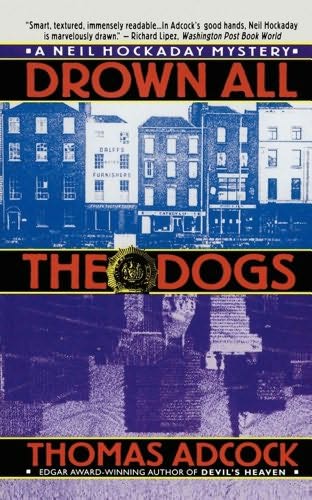
Drown All The Dogs: Thomas Adcock

Drown All The Dogs is a paperback I picked up at a great little store in Portland called Murder By The Book. I bought this book years ago and am only now finally reading it. I think I needed to read this book as an adult, as it's pretty thick stuff. It's an Irish cop mystery intricately woven with Irish history and literature.
Neil Hockaday is a New York cop of Irish descent who spends his time in Hell's Kitchen, trying to fill the "hollow places" inside him. Ruby Flagg is his gal pal who gives strong, independent woman a good name. In an effort to solve the mystery of Hockaday's faceless father, Neil and Ruby take a vacation across the pond to visit old Uncle Liam. From there, the mysteries pile up faster than the body count, with Neil at the epicenter.
I'm still not sure I fully understand this book. The Irish Republic Army, Nazis, secret organizations, and so much convoluted patriotism create a web of deceit that our New Yorker cop has to untangle to reveal the truth about his family. Unfortunately, some places are so tangled and dark that they may better be left alone.
While reading this novel, I couldn't help but wonder how much our family history defines us. For some folks, I think that lineage is just history. For others, I think that family is defining. What ugly secret would it take for you to disown your familial history? Imagine that you learned that your ancestors had committed horrendous crimes. How would that effect you?
Adcock is not the best, most articulate writer being published, but his story is detailed and smart. It takes a real talent to incorporate so much information into a novel and keep it interesting. What could read like a history book, instead reads like a novel, with developed characters and a driving plot line.
Sunday, May 17, 2009
Angels & Demons: Dan Brown
First of all, I want to apologize for being away from the blog for so long. I've had computer issues, and then I went on vacation. Needless to say, I've got a lot of catching up to do!

Dan Brown, the author of the well-known The DaVinci Code, actually wrote Angels & Demons first. This first novel of his is quite a bit darker than his other more publicized work. I was fortunate enough to catch a bit of an interview with Ron Howard and the main characters of the upcoming film and gained some insight into why The DaVinci Code was produced first. For one thing, as I noticed in my own readings, Angels & Demons jumps into the story without much character development of Robert Langdon. Whether that was intentional or if Brown simply became a more developed writer is unknown. In any case, Ron Howard felt that exposing the public to Robert Langdon in full dose by releasing Angels & Demons first, the audience would feel little empathy for a character who was basically a stranger. In The DaVinci Code, Howard was careful to help Tom Hanks fill out the character, and now, when we see him in Angels & Demons, he is a real person to us.
I think most important to note about this novel is that the Catholic church is no longer in direct light. It would be a simple overstatement to say that Angels & Demons is a story of good vs. evil, or wrong and right existing together to keep the checks and balances in place. This volume has a personal attachment that I didn't really feel from The DaVinci Code. The fact that this story involves men of the cloth isn't a condemnation because these men are drawn up as real people. The human element of this novel makes the murder and mystery all the more involved, and less about faith than it is about some of the basic human instincts.
To give a brief overview, Langdon is called in as a Symbologist Extraordinaire to help identify the creator of an Illuminati sign. What begins as an identification turns into a global manhunt. Meanwhile, a form of antimatter has been invented, and consequently stolen and is now being used as a weapon against Vatican City. It's a fascinating story from page one, if not slightly predictable once you get acquainted with all of the characters.
I enjoyed Angels & Demons, though I have to say, I think I preferred The DaVinci Code. Everyone told me that Angels & Demons was the better of the two novels, so I expected something to knock my socks off. I liked it, but I was far more intrigued by the mysteries of The DaVinci Code.

Dan Brown, the author of the well-known The DaVinci Code, actually wrote Angels & Demons first. This first novel of his is quite a bit darker than his other more publicized work. I was fortunate enough to catch a bit of an interview with Ron Howard and the main characters of the upcoming film and gained some insight into why The DaVinci Code was produced first. For one thing, as I noticed in my own readings, Angels & Demons jumps into the story without much character development of Robert Langdon. Whether that was intentional or if Brown simply became a more developed writer is unknown. In any case, Ron Howard felt that exposing the public to Robert Langdon in full dose by releasing Angels & Demons first, the audience would feel little empathy for a character who was basically a stranger. In The DaVinci Code, Howard was careful to help Tom Hanks fill out the character, and now, when we see him in Angels & Demons, he is a real person to us.
I think most important to note about this novel is that the Catholic church is no longer in direct light. It would be a simple overstatement to say that Angels & Demons is a story of good vs. evil, or wrong and right existing together to keep the checks and balances in place. This volume has a personal attachment that I didn't really feel from The DaVinci Code. The fact that this story involves men of the cloth isn't a condemnation because these men are drawn up as real people. The human element of this novel makes the murder and mystery all the more involved, and less about faith than it is about some of the basic human instincts.
To give a brief overview, Langdon is called in as a Symbologist Extraordinaire to help identify the creator of an Illuminati sign. What begins as an identification turns into a global manhunt. Meanwhile, a form of antimatter has been invented, and consequently stolen and is now being used as a weapon against Vatican City. It's a fascinating story from page one, if not slightly predictable once you get acquainted with all of the characters.
I enjoyed Angels & Demons, though I have to say, I think I preferred The DaVinci Code. Everyone told me that Angels & Demons was the better of the two novels, so I expected something to knock my socks off. I liked it, but I was far more intrigued by the mysteries of The DaVinci Code.
Friday, March 20, 2009
The Westing Game: Ellen Raskin

The Westing Game by Ellen Raskin is on almost every young adult booklist. It is a book that I thought I had read as a student and really enjoyed, so I decided to go back for a re-read. However, by the time I finished the first chapter I knew that I was mistaken. So this was a new read for me, and I really enjoyed it. I can see why it's on all the best booklists!
The Westing Game is really a murder mystery game, orchestrated by Sam Westing. With a cast of 16 possible Westing heirs and their various sidekicks, The Westing Game reads a bit like a game of Clue. From page one I was pulled into the plot of piecing together the mystery of Sam Westing's death. With such a large cast of suspects, every person holds a secret that is key to the truth. I was most entertained by Mrs. Hoo--the Chinese woman who speaks practically no English. After a bomber starts setting off bombs in the apartment building, Mrs. Hoo learns the word "boom" and walks around frightening people by cheerfully saying "Boom!" and smiling like an idiot.
I admit that I am a fan of stories that wrap up neatly in the end. Reality is harsh enough--when I read a story or see a movie, I want a plausible though improbable happy ending. I want to put down the book with a smile and the knowledge that it's really possible for the guy to get the girl and the bad guy to get thrown in jail. The Westing Game ties up very neatly without being too trite. For a young adult book, this is a very mature story that doesn't talk down to young readers, while still appealing to an adult audience.
Subscribe to:
Posts (Atom)